
A review of 60 human studies finds substantial reductions in biomarkers of harmful chemical exposure when smokers switch completely to e-cigarettes. Here’s what the research tells us—and what it doesn’t.
If you’ve switched from smoking cigarettes to vaping, you’ve probably spent some time thinking about what’s in your vape juice.
Maybe you’ve researched ingredients, compared devices, looked into laboratory testing, or wondered whether one type of e-liquid produces a cleaner aerosol than another.
Those are reasonable questions. We believe ingredient quality and product testing matter, and we’ve spent years investigating them ourselves.
But sometimes, in the process of examining every ingredient and every potentially harmful chemical, it’s easy to lose sight of a much bigger question:
How does the chemical exposure associated with vaping compare to the exposure from smoking cigarettes?
A major scientific review published in October 2026 provides some encouraging evidence.
The researchers examined 60 human studies and found that people who switched completely from cigarettes to e-cigarettes generally had substantially lower levels of biomarkers associated with exposure to many harmful chemicals found in cigarette smoke.
The findings don’t mean vaping is harmless. They don’t tell us that every vaping product is equally safe, or that reduced chemical exposure automatically translates into a particular reduction in disease risk.
But they do help put the differences between smoking and vaping into perspective.
A New Look at What Happens When Smokers Switch
The study, published October 23, 2026, in the peer-reviewed journal Archives of Toxicology, is titled:
Rather than conducting a single new experiment, the researchers systematically reviewed existing scientific studies to examine what happens to chemical exposure when people stop smoking cigarettes and begin using e-cigarettes instead.
The review included 60 human studies. Of these, six publications representing seven distinct study-level sources provided sufficiently comparable data for a quantitative meta-analysis covering ten biomarkers of exposure.
The results were striking.
Across all ten biomarkers included in the meta-analysis, average measured levels were lower among people who had switched completely to vaping or were exclusively vaping after previously smoking.
The estimated reductions ranged from approximately 61% to 92%, depending on the chemical being measured.
These were not estimates of reduced disease risk. They were measurements of chemical exposure, which is an important distinction we’ll explore below.
What Are Biomarkers, and Why Do They Matter?
When scientists study the chemicals produced by cigarettes or vaping devices, they can analyze the smoke or aerosol itself.
That tells us what a product emits under particular testing conditions.
But there’s another way to investigate exposure: measure what actually enters the human body.
That’s where biomarkers come in.
A biomarker of exposure is a measurable substance or biological indicator—often found in blood, urine, or exhaled breath—that provides evidence of exposure to a particular chemical.
For example, researchers can measure:
NNAL: A biomarker associated with exposure to NNK, a tobacco-specific carcinogenic nitrosamine.
3-HPMA: A urinary metabolite used to assess exposure to acrolein, a potentially harmful chemical found in cigarette smoke and some e-cigarette aerosols.
S-PMA: A biomarker of benzene exposure.
Carbon monoxide: A toxic gas produced by combustion that can be measured in exhaled breath.
Carboxyhemoglobin: A blood marker reflecting exposure to carbon monoxide.
These measurements help scientists understand exposure under real-world or controlled-use conditions.
This is particularly valuable because the amount of a chemical detected in an aerosol doesn’t necessarily tell us how much of that chemical a person absorbs.
Biomarker studies provide another important piece of the puzzle.
How Much Did Chemical Exposure Decline?
The researchers calculated average changes in ten biomarkers after complete switching from cigarettes to e-cigarettes or among exclusive e-cigarette users with a smoking history.
Here are the approximate reductions reported in the meta-analysis:
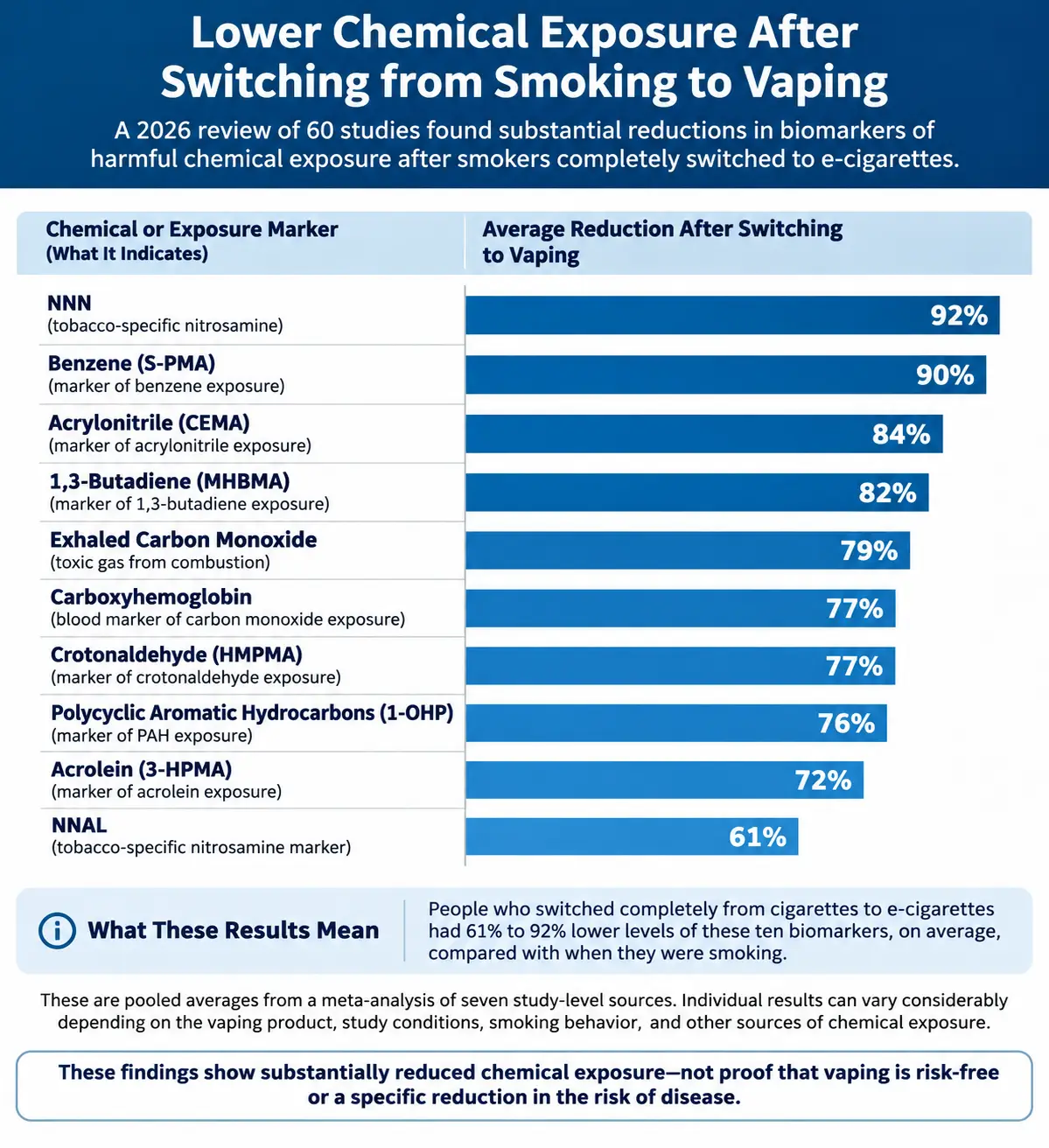
The researchers found considerable variation between studies. Differences in devices, study conditions, participant behavior, and other factors may help explain why some studies observed larger reductions than others.
Nevertheless, the overall pattern was consistent: the pooled estimates were lower for all ten biomarkers.
To understand why this matters, consider two examples.
Carbon monoxide: Burning tobacco produces carbon monoxide, which interferes with the blood’s ability to transport oxygen. Because e-cigarettes heat liquid rather than burn tobacco, switching away from cigarettes can substantially reduce this source of exposure.
Tobacco-specific nitrosamines: These chemicals are associated with tobacco and include known carcinogens. The substantial reductions in their biomarkers suggest that switching completely away from combustible cigarettes can significantly change exposure to these substances.
The findings illustrate an important principle: eliminating tobacco combustion changes the mixture of chemicals to which a person is exposed.
Why Getting Away From Combustion Matters
Cigarettes burn tobacco. E-cigarettes heat a liquid to produce an aerosol.
That difference may sound simple, but from a toxicological perspective, it’s enormously important.
Burning tobacco creates a complex mixture containing thousands of chemicals, including carbon monoxide, carcinogenic compounds, and other toxic substances.
Many of these chemicals are products of combustion itself.
E-cigarettes don’t burn tobacco, so they avoid the primary source of many combustion-related toxicants.
However, vaping aerosol is not simply harmless water vapor.
Depending on the device, ingredients, and operating conditions, e-cigarette aerosols may contain potentially harmful substances, including certain carbonyl compounds and metals.
Some of these chemicals can form when e-liquid ingredients are heated. Others may originate from device components or impurities.
This is why we believe both statements can be true:
Switching completely from smoking to vaping can substantially reduce exposure to many harmful chemicals.
The composition and quality of vaping products still matter.
These ideas aren’t contradictory. They’re different parts of the same scientific picture.
Complete Switching Makes a Difference
One of the most important findings from the review concerns the difference between people who switch completely to vaping and those who continue to smoke cigarettes while also vaping.
The researchers found that reductions in harmful chemical exposure were generally greatest when cigarette smoking was eliminated entirely.
Among people who used both cigarettes and e-cigarettes—commonly called dual users—the reductions tended to be smaller and less consistent.
This makes sense.
If someone begins vaping but continues smoking cigarettes, they’re still exposing themselves to the toxic substances produced by burning tobacco.
How much their exposure changes depends partly on how many cigarettes they stop smoking.
For an adult smoker who chooses vaping as an alternative to cigarettes, this distinction is important.
The evidence suggests that completely replacing cigarettes is more likely to produce substantial reductions in exposure than simply adding vaping while continuing to smoke.
Reducing cigarette consumption may be a step toward quitting smoking, but dual use shouldn’t be assumed to provide the same exposure reductions as complete switching.
What About Nicotine?
One interesting aspect of the broader research concerns nicotine.
Nicotine is the substance primarily responsible for tobacco dependence, and it is not harmless. It can affect the cardiovascular system, is particularly concerning during pregnancy and adolescence, and can sustain addiction.
However, nicotine itself is not responsible for most of the toxic chemicals generated when tobacco burns.
Some of the studies reviewed found that nicotine exposure remained similar after switching to e-cigarettes, even while exposure to numerous other toxicants declined substantially.
In other words, people could continue obtaining nicotine while reducing exposure to many chemicals associated with cigarette smoke.
This distinction is central to understanding tobacco harm reduction.
It also helps explain why measuring nicotine exposure alone doesn’t tell us whether someone is receiving the same exposure to the toxic chemicals found in cigarettes.
For adults who don’t use nicotine, there is no health benefit to starting. For adults who smoke, quitting cigarettes and all nicotine products is preferable when achievable.
But for people who continue using nicotine, the method of delivery can make a meaningful difference in chemical exposure.
Does Lower Chemical Exposure Mean Lower Health Risks?
This is where scientific precision becomes especially important.
The researchers measured and analyzed biomarkers of exposure, not long-term rates of cancer, cardiovascular disease, or other smoking-related illnesses.
A lower level of a harmful chemical in the body is encouraging, particularly when that chemical is known to contribute to disease.
But a 90% reduction in a biomarker does not automatically mean a 90% reduction in the risk of developing a disease.
The relationship between exposure and health outcomes is more complicated.
Disease risk depends on many factors, including the chemicals involved, cumulative exposure, individual susceptibility, prior smoking history, and duration of use.
Some health effects may take decades to develop.
The researchers also examined studies of biomarkers of potential harm, such as indicators of inflammation, oxidative stress, and vascular function. Those results were more variable and could not be combined into the same kind of quantitative analysis.
Consequently, the authors were careful not to claim that their findings establish long-term vaping safety or a specific reduction in disease risk.
That limitation matters.
The study provides evidence of substantially reduced exposure to several harmful chemicals—not proof that vaping is risk-free.
What Are the Limitations of This Research?
No scientific study should be evaluated solely by its headline findings.
This review has several important limitations worth understanding.
First, although the researchers reviewed 60 studies, only seven study-level sources contributed to the quantitative meta-analysis. That means the percentage reductions were calculated from a smaller evidence base than the headline number of 60 might suggest.
Second, the results varied considerably between studies. Products, testing conditions, study designs, and participant behavior were not identical.
Third, many of the switching studies were relatively short. Some lasted only several days, while others followed participants for weeks or months. These studies are useful for measuring changes in chemical exposure but cannot establish lifetime health outcomes.
Fourth, five of the seven study-level sources contributing to the meta-analysis were funded or co-authored by tobacco or e-cigarette manufacturers, accounting for 40 of the 47 biomarker-specific effects analyzed. The systematic review itself reported receiving no specific funding.
Industry involvement doesn’t automatically invalidate research, particularly when outcomes are measured using validated laboratory methods. However, it raises legitimate questions about product selection, study design, and how broadly the findings can be applied. Independent replication remains important.
Finally, the study did not establish that every e-cigarette product produces the same exposure profile.
Devices, formulations, and user behavior vary considerably.
The researchers acknowledged these limitations, and readers should keep them in mind when interpreting the results.
The meta-analysis also did not quantify exposure changes for every potentially harmful constituent of vaping aerosols, including metals. Its findings should not be interpreted as a comprehensive safety assessment of all vaping products.
Where Does Product Testing Fit Into the Picture?
At Kai’s Virgin Vapor, we’ve spent years investigating the ingredients used in e-liquids and the potentially harmful chemicals that may be present in vaping products.
Our approach has included ingredient screening, laboratory analysis, and publishing testing results so customers can examine the information themselves.
We’ve also written extensively about harmful and potentially harmful constituents (HPHCs) and the importance of understanding what laboratory tests actually measure.
The 2026 review adds useful perspective to that discussion.
Laboratory testing of an e-liquid or aerosol helps answer questions about a particular product under specific testing conditions.
Human biomarker studies help answer a different question: how does exposure inside the body change when someone switches from one product category to another?
Both types of research are valuable.
And both have limitations.
We believe consumers deserve access to meaningful product information, including ingredient disclosures and laboratory results where available.
But we also believe it’s important not to lose sight of the larger comparison.
For someone who previously smoked cigarettes and now vapes exclusively, the most significant change in exposure to many harmful chemicals may have come from eliminating cigarette smoke in the first place.
That doesn’t make further improvements in product quality unimportant.
It simply puts them in context.
The Bigger Picture: Don’t Lose Sight of the Cigarettes
When discussing vaping, it’s easy to become focused on individual chemicals, device differences, or the latest laboratory finding.
Those details deserve attention.
But they shouldn’t obscure the broader scientific question.
For an adult who has never smoked, taking up vaping introduces unnecessary exposure and potential risks.
For an adult who currently smokes cigarettes, however, the relevant comparison is often very different.
It’s not simply vaping versus breathing clean air.
It’s continuing to inhale cigarette smoke versus completely replacing cigarettes with a noncombustible alternative.
The October 2026 review provides evidence that this change can substantially reduce exposure to numerous harmful chemicals associated with smoking.
It doesn’t tell us that vaping is safe. It doesn’t establish the long-term health effects of every vaping product. And it doesn’t eliminate the value of choosing carefully formulated, appropriately tested products.
But it does reinforce an important point:
If you’ve completely replaced cigarettes with vaping, don’t overlook the significance of having eliminated tobacco combustion—even as you continue asking questions about the products you use.
At Kai’s Virgin Vapor, we believe everyone deserves accurate information and the freedom to make informed choices about their own health. Whether your goal is to stay away from cigarettes, gradually reduce your nicotine intake, or stop vaping altogether, we support you in finding the path that’s right for you.
If you’ve already transitioned away from smoking cigarettes and you’re thinking about taking that next step, our How to Quit Vaping guide offers practical strategies and encouragement to help you get started.
Scientific understanding advances by examining both the big picture and the details. We think consumers deserve both.
Scientific Sources
1. Adebisi, Y. A., et al. (2026). Changes in human biomarkers of exposure after complete switching from cigarettes to e-cigarettes or exclusive e-cigarette use: a systematic review and biomarker-specific meta-analysis. Archives of Toxicology. Published October 23, 2026.
2. National Academies of Sciences, Engineering, and Medicine. (2018). Public Health Consequences of E-Cigarettes. Washington, DC: The National Academies Press.
3. Goniewicz, M. L., et al. (2018). Comparison of nicotine and toxicant exposure in users of electronic cigarettes and combustible cigarettes. JAMA Network Open, 1(8), e185937.
Related reading from Kai’s Virgin Vapor: