
Last Updated: October 2026
When researchers at Harvard published a study examining potentially harmful flavoring chemicals in electronic cigarettes in December 2015, the findings generated considerable attention.
The researchers detected at least one of three chemicals—diacetyl, acetoin, and 2,3-pentanedione—in 47 of the 51 flavored e-cigarette products they tested.
For many consumers, this was their first introduction to diacetyl and its association with a serious lung disease commonly called popcorn lung.
For us at Kai’s Virgin Vapor, however, the subject was already familiar.
We had been investigating these chemicals, questioning flavor suppliers, and developing our own laboratory testing procedures as part of our commitment to understanding exactly what went into our e-liquids. By the time the diacetyl issue hit the news, we already had our own full-time PhD chemist on staff and an in-house lab equipped with our own GC-MS machine specifically to test for diacetyl and related compounds in our products.
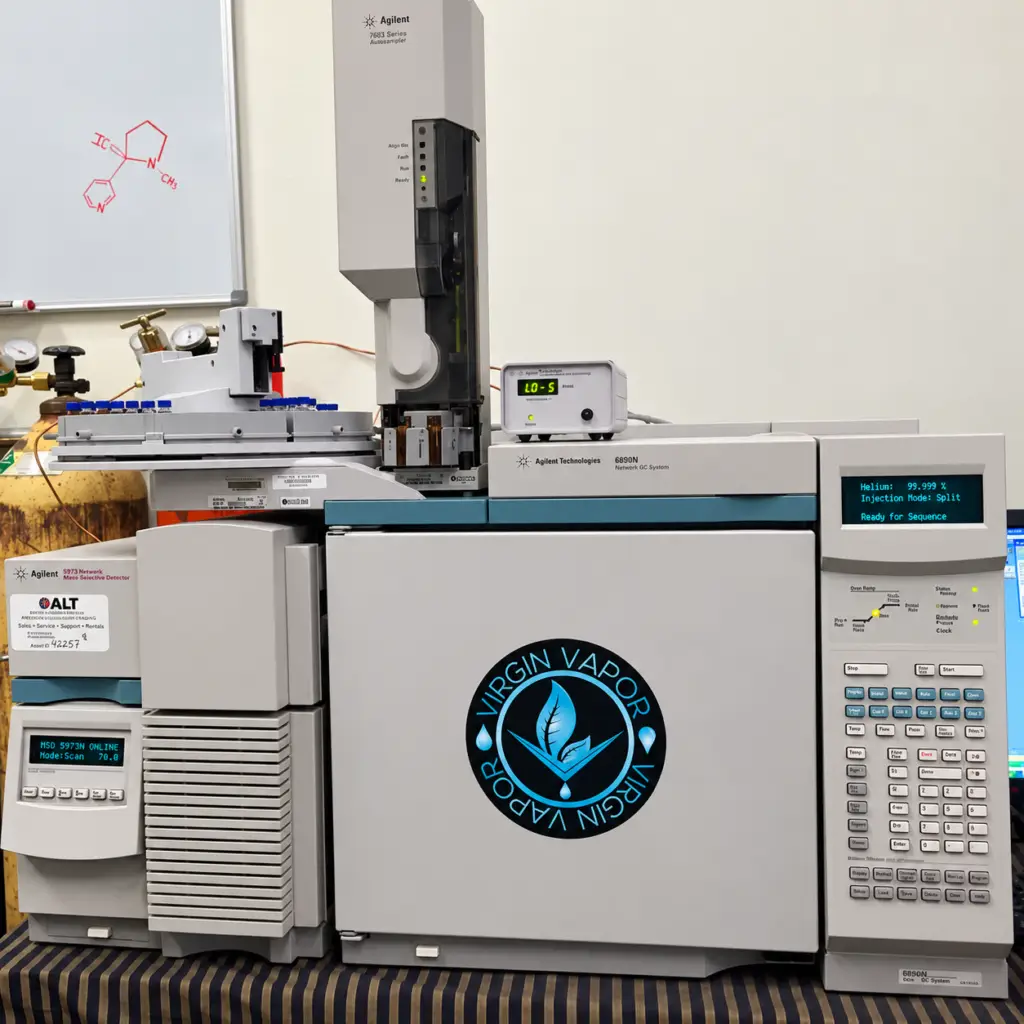
The Harvard study brought wider attention to an issue we believed the vaping industry should have been addressing long before it made headlines.
So what is diacetyl, what does the science actually tell us about its risks, and why is independent laboratory testing so important?
What Is Diacetyl?
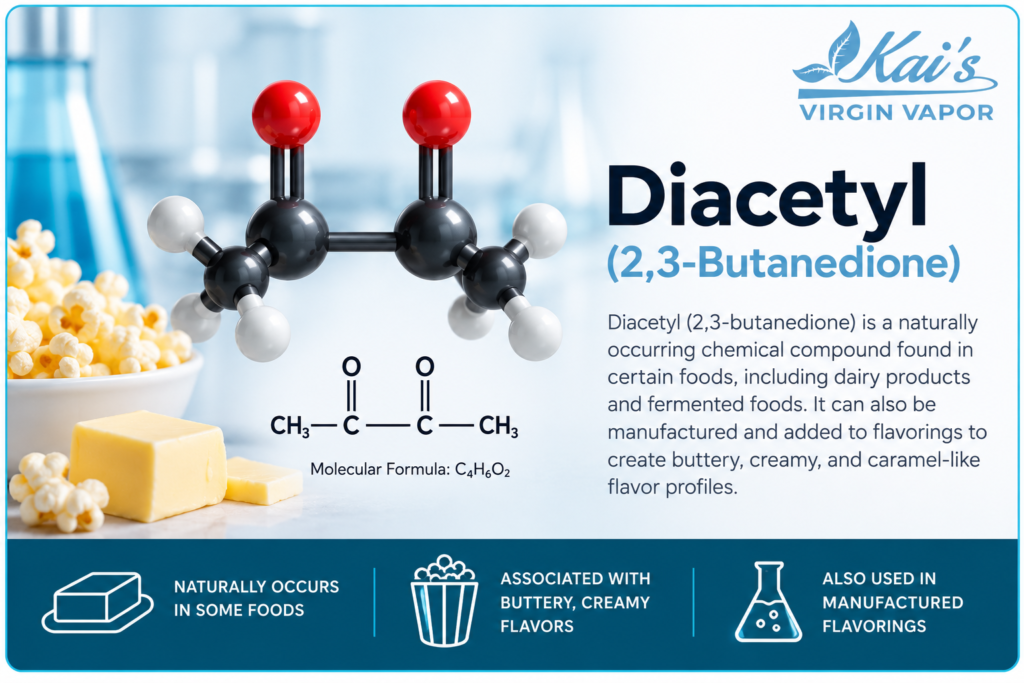
Diacetyl (2,3-butanedione) is a naturally occurring chemical compound associated with buttery, creamy flavors and aromas.
Diacetyl occurs naturally in certain foods, including some dairy products and fermented foods. It can also be manufactured and added to flavorings to create buttery, creamy, and caramel-like flavor profiles.
Its presence in food, however, raises an important distinction: An ingredient that can be consumed in food is not necessarily safe to inhale.
Our digestive system and respiratory system are very different. A chemical’s suitability for use in food does not establish its safety when heated, aerosolized, and inhaled into the lungs.
This distinction is particularly important when evaluating flavoring ingredients intended for e-liquids.
What Is Popcorn Lung, and How Is It Connected to Diacetyl?
Popcorn lung is the informal name for bronchiolitis obliterans, also called obliterative bronchiolitis.
It is a serious, irreversible lung disease involving inflammation and scarring of the small airways, which can restrict airflow and make breathing increasingly difficult.
The nickname “popcorn lung” originated following investigations into respiratory illness among workers at microwave popcorn manufacturing facilities. Some workers had experienced substantial occupational exposure to butter flavorings containing diacetyl.
Subsequent investigations identified associations between workplace exposure to diacetyl and severe respiratory impairment, including obliterative bronchiolitis.
The National Institute for Occupational Safety and Health (NIOSH) has also identified concerns involving 2,3-pentanedione, a chemical sometimes used as a substitute for diacetyl.
These findings established an important principle: chemicals used to make food taste appealing can present very different hazards when inhaled.
Does Diacetyl in Vape Juice Cause Popcorn Lung?
This question requires a careful distinction between an established inhalation hazard and the specific risks associated with vaping.
The association between occupational diacetyl exposure and serious respiratory disease is well established. However, the evidence from workers exposed in industrial settings cannot automatically be translated into an equivalent risk estimate for someone using an electronic cigarette.
Exposure levels, duration, chemical mixtures, and conditions can differ substantially.
The Harvard study established that these flavoring chemicals could be detected in aerosols from many of the e-cigarette products examined. It did not demonstrate that the people using those products had developed bronchiolitis obliterans. At the same time, the absence of a directly established disease rate among vapers does not demonstrate that inhaling diacetyl is safe.
For manufacturers, the responsible response is to take the identified inhalation hazard seriously rather than waiting for additional evidence of harm.
What Did the Harvard Diacetyl Study Actually Find?
The study, published online in December 2015 in Environmental Health Perspectives, examined 51 flavored electronic cigarette products.
Researchers analyzed the aerosol produced by the devices, looking for three specific flavoring chemicals.
Their findings were significant:
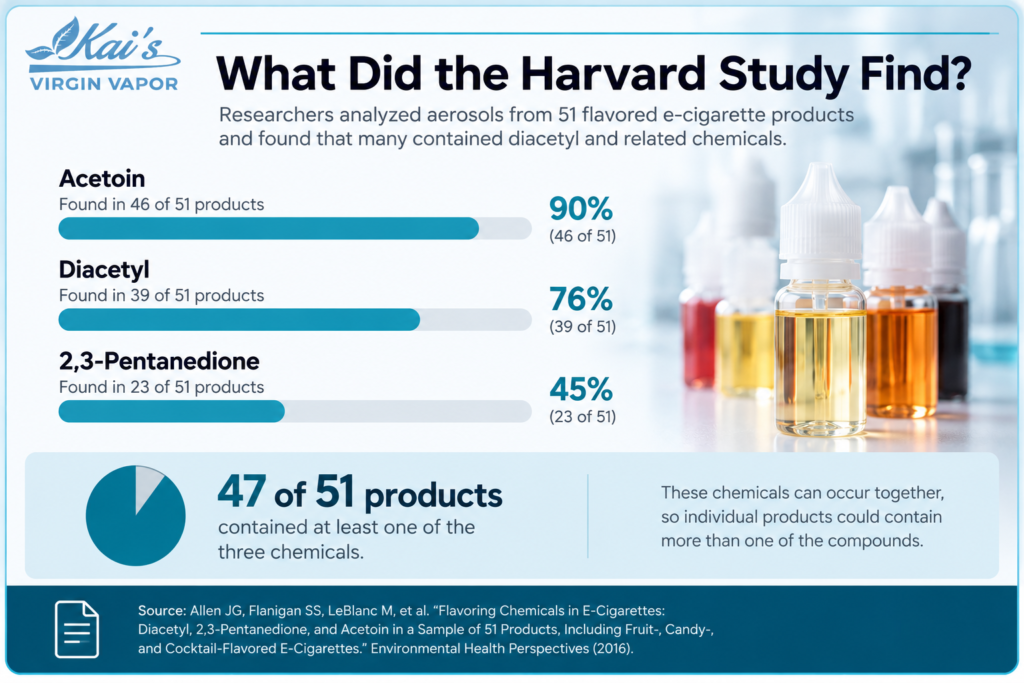
Although the study examined a selected sample of products rather than the entire e-liquid market, its findings demonstrated that these chemicals were present across multiple products and flavor categories—not just an isolated flavor or manufacturer.
Read the original Harvard study.
Should Smokers Be More Concerned About Diacetyl in Vaping Than in Cigarettes?
One important detail was frequently overlooked in the headlines surrounding the Harvard study: diacetyl is also present in conventional cigarette smoke.
This matters because the discovery of a potentially harmful chemical in e-cigarette aerosol should not be interpreted to mean that returning to smoking is a safer choice.
Cigarette smoke contains thousands of chemicals, including numerous known carcinogens and toxic substances. The health risks of smoking are extensive and well established. Although vaping is most certainly not risk-free, public health authorities generally recognize that completely switching from combustible cigarettes to e-cigarettes can reduce exposure to many harmful chemicals.
But this doesn’t mean we should dismiss concerns about diacetyl in vape juice simply because cigarettes contain it, too.
In fact, we believe the opposite.
One of the potential advantages of manufacturing e-liquids is the opportunity to identify and avoid particular ingredients of concern before they ever reach the finished product.
Why accept an avoidable inhalation hazard when we have the analytical tools to investigate it?
For smokers considering alternatives, the important distinction is this: The presence of diacetyl in some vaping products is a legitimate reason to demand better ingredient testing—not a reason to assume that smoking cigarettes is safer.
Eliminating tobacco and nicotine use entirely remains the healthiest goal. For adults who would otherwise continue smoking, however, accurate information about relative risks is far more useful than frightening headlines that leave out the bigger picture.
Diacetyl, Acetoin, and Acetyl Propionyl: Why Test for All Three?
One of the most important lessons we learned through our early testing was that looking for diacetyl alone was not enough.
Three compounds deserve particular attention:
Diacetyl (2,3-butanedione): A flavoring chemical associated with severe respiratory disease following occupational inhalation exposure.
2,3-Pentanedione (acetyl propionyl): A structurally related flavoring chemical that has demonstrated respiratory toxicity in animal studies and is also a concern in occupational health research.
Acetoin (3-hydroxy-2-butanone): Another flavoring compound frequently examined alongside diacetyl and 2,3-pentanedione. Its toxicological evidence is not identical to that of the other two chemicals, and it should not automatically be described as carrying the same established disease risk.
Testing for all three provides a more complete understanding of a flavor formulation than testing for diacetyl alone.
It also helps manufacturers avoid replacing one ingredient of concern without adequately investigating the alternatives.
Why We Invested in Our Own GC-MS Laboratory
When Kai’s Virgin Vapor began developing its quality-control program, we wanted more than ingredient declarations and assurances from suppliers.
We wanted analytical evidence.
Working with a full-time Ph.D. chemist, we established laboratory procedures and invested in our own gas chromatography–mass spectrometry (GC-MS) equipment.
GC-MS is an analytical technique used to separate and identify chemical compounds in a sample. With an appropriately developed and validated method, it can be used to investigate the presence of specific flavoring chemicals.
Having this capability in-house gave us a valuable tool for investigating ingredients, evaluating suppliers, and making informed formulation decisions.
It also fundamentally changed how we approached quality control.
Rather than assuming that a flavoring was suitable because its manufacturer described it as natural, organic, or free from a particular ingredient, we could ask a more meaningful question:
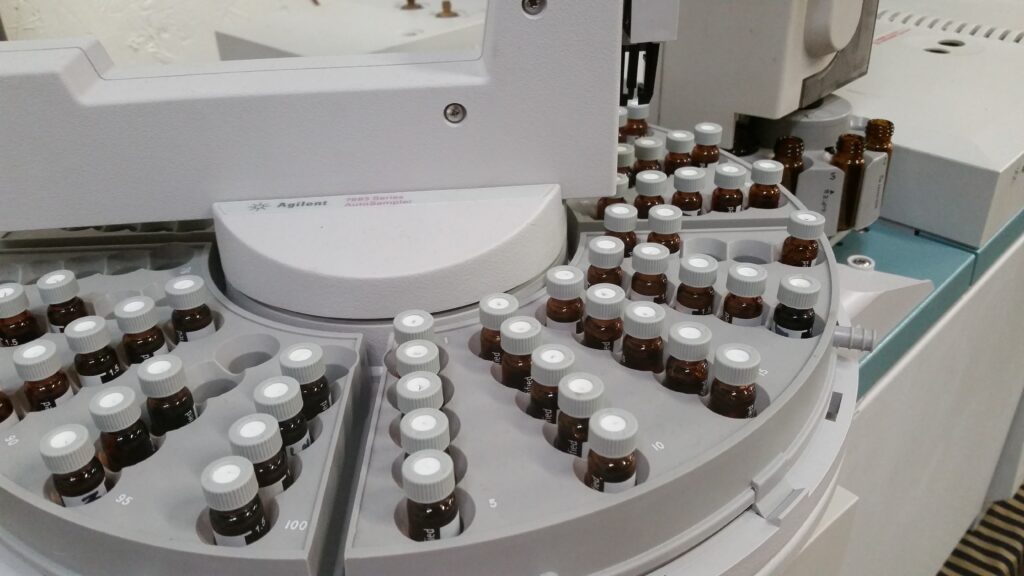
GC-MS testing samples.
What does the laboratory evidence actually show?
As our testing program evolved, we also began using independent laboratories specializing in e-liquid analysis. While our in-house GC-MS equipment gave us the ability to investigate ingredients ourselves, third-party testing added another important layer of verification.
We wanted our customers to have more than our word that we were doing the right thing. We wanted them to be able to see the evidence for themselves.
From Our Founder: Why Supplier Assurances Weren’t Enough
The following reflects our founder’s firsthand experience developing Kai’s original testing program.
When I first began investigating diacetyl, I expected flavor manufacturers to be able to answer straightforward questions about their ingredients.
What I discovered was considerably more frustrating.
Some flavor suppliers assured us that their flavorings were diacetyl-free. But when we obtained independent laboratory results, we sometimes found that those assurances did not match the analytical findings.
In certain cases, I confronted suppliers with the test results, only to encounter resistance rather than a willingness to investigate the discrepancy.
One experience that particularly stayed with me involved a conversation with a senior executive at a major e-liquid manufacturer.
When I asked whether the company’s products contained diacetyl, he confidently told me they did not.
I then asked about 2,3-pentanedione.
The look on his face left me concerned that he was unfamiliar with the compound, although he assured me it wasn’t present either.
When I brought a sample back for testing, as I suspected, our results did not detect diacetyl but did identify substantial amounts of 2,3-pentanedione.
That experience reinforced something I had already begun to understand: eliminating one ingredient of concern means very little if you aren’t investigating the broader formulation.
It was experiences like these that shaped our approach to quality control.
We didn’t invest in laboratory equipment because it was an attractive marketing feature. We invested in testing because we wanted answers we could verify. And as people who used our own products, we had a very personal interest in making the cleanest e-liquid we knew how to make.
Our philosophy became simple:
Never Assume. Test.
Why a Diacetyl-Free Label Isn’t Enough
A supplier’s declaration can be useful documentation, but it is not the same thing as an independent analytical test.
There are several reasons why a product described as diacetyl-free deserves closer examination.
First, the claim may reflect the supplier’s formulation rather than comprehensive testing of the finished ingredient.
Second, the supplier may be using a particular analytical detection threshold. A result reported as not detected does not necessarily mean that absolutely none of the chemical exists in the sample.
Third, the declaration may not address related compounds such as 2,3-pentanedione or acetoin.
Finally, formulations and ingredient sources can change over time.
For these reasons, we believe manufacturers should evaluate the actual ingredients they purchase, obtain appropriate laboratory documentation, and investigate unexpected results rather than relying exclusively on marketing claims from their suppliers.
Can Diacetyl Be Found in Fruit and Other Non-Creamy Vape Flavors?
Yes. One of the misconceptions surrounding diacetyl is that consumers can avoid it simply by staying away from buttery, creamy, or custard-style e-liquids.
Our historical ingredient testing demonstrated why that assumption was unreliable.
We encountered concerning findings across a range of flavor categories, including coffee, candy, bakery, and some fruit flavorings.
The Harvard researchers also detected the chemicals they investigated across multiple flavor categories. A flavor’s name or taste is not a reliable substitute for analytical testing.
A product described as fruity, refreshing, natural, or organic should not automatically be assumed to be free from particular flavoring chemicals.
What Should Consumers Look for in an E-Liquid Laboratory Report?
Consumers interested in ingredient transparency should look beyond a simple claim that a product has been lab tested.
A meaningful report should help answer several questions:
- Which specific chemicals were tested?
- Was the sample a concentrated flavoring, a finished e-liquid, or an aerosol?
- What analytical method did the laboratory use?
- What were the detection and quantification limits?
- When was the sample tested?
- Can the report be connected to the relevant product, formulation, or batch?
- Was testing performed internally or by an independent laboratory?
These distinctions matter.
For example, a result of not detected means that a substance was not detected under the conditions and limits of that particular test. It does not necessarily establish absolute absence.
Similarly, testing a concentrated flavor ingredient and testing the aerosol produced by a finished vaping device answer different questions.
Laboratory reports provide valuable information, but their conclusions should be understood within the scope of the testing performed.
📋 Not sure how to read a laboratory report? Our step-by-step guide, How to Read a Vape Juice Lab Report, explains what the results mean, which numbers matter, and what to look for when evaluating a manufacturer’s testing claims.
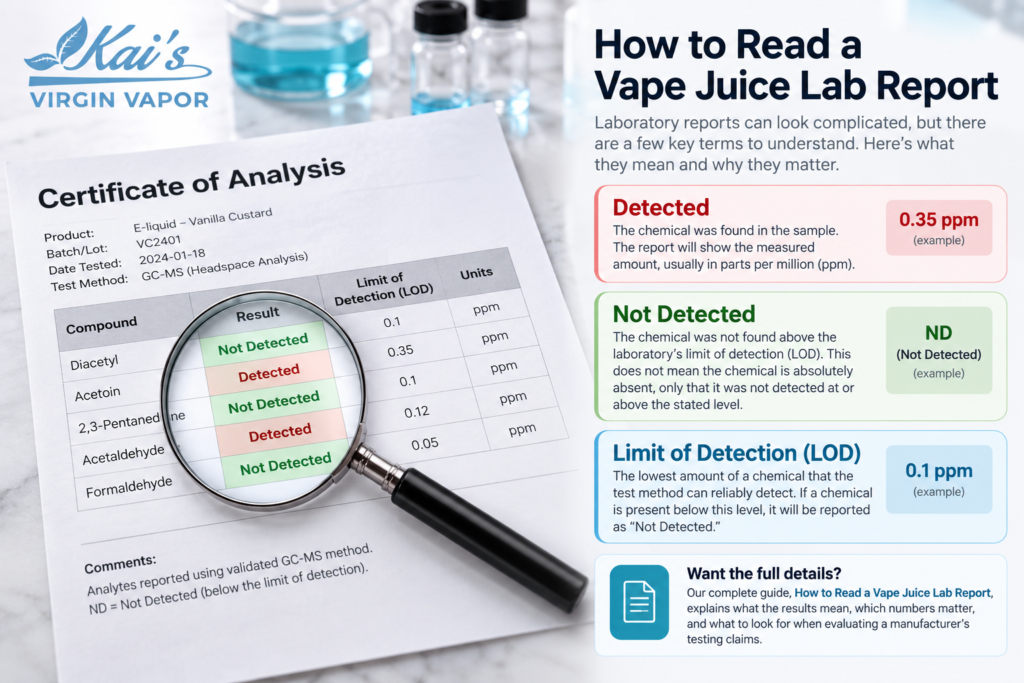
To see an actual lab report, check out our lab test results by flavor.
Our Commitment to Ingredient Transparency
At Kai’s Virgin Vapor, we believe that knowing what’s in our products is our responsibility—not something we should leave to chance or take on faith.
That’s why we invested in our own analytical laboratory, employed a full-time Ph.D. chemist, and developed rigorous ingredient-screening procedures to guide our formulation decisions. As our business evolved and we moved away from developing new formulations, we transitioned to independent third-party laboratories for our ongoing testing.
These weren’t steps we were required to take. They were decisions we made because we believed they were the right thing to do.
We also believe that test results shouldn’t be hidden behind marketing language. Customers deserve access to meaningful laboratory documentation and clear explanations of what those results show.
Our philosophy is simple: Never Assume. Test.
The Bottom Line: Don’t Assume. Ask for Evidence.
More than a decade after the Harvard study brought widespread attention to diacetyl in vaping products, its underlying lesson remains relevant.
Flavoring chemicals should not be evaluated solely on their taste, their suitability for food, or the assurances of their suppliers.
Their potential inhalation hazards deserve serious consideration.
Consumers should be able to ask manufacturers what they test for, how they test, and whether supporting documentation is available.
And manufacturers should be willing to answer those questions accurately—even when the answers require further investigation.
At Kai’s Virgin Vapor, that belief helped shape our quality-control program from the beginning.
🔬 See the Results for Yourself: We believe in transparency. Explore Kai’s Virgin Vapor’s Laboratory Test Results
Scientific References
- Allen JG, et al. (2016). Flavoring Chemicals in E-Cigarettes: Diacetyl, 2,3-Pentanedione, and Acetoin in a Sample of 51 Products, Including Fruit-, Candy-, and Cocktail-Flavored E-Cigarettes. Environmental Health Perspectives, 124(6), 733–739. https://doi.org/10.1289/ehp.1510185
- CDC/NIOSH. Flavorings and Lung Disease. Updated February 24, 2025. https://www.cdc.gov/niosh/flavoring-related-lung-disease/about/index.html
- CDC/NIOSH. Criteria for a Recommended Standard: Occupational Exposure to Diacetyl and 2,3-Pentanedione. DHHS Publication No. 2016-111. https://www.cdc.gov/niosh/docs/2016-111/default.html
Editorial note: This article discusses ingredient testing and scientific research for educational purposes. It does not establish that vaping is safe or that laboratory testing eliminates the health risks associated with inhaling e-cigarette aerosol.