
You found an old bottle of vape juice in a drawer and now you’re wondering:
Does vape juice expire? Is it unsafe? Or is it probably still fine?
 The short answer is:
Vape juice usually lasts a surprisingly long time when stored properly. It does not typically “spoil” like milk or food. Instead, it undergoes gradual changes. Nicotine may slowly weaken, flavors can mellow or shift, and the liquid may darken—but that doesn’t automatically mean it has gone bad.
In fact, one of the biggest factors is often how the bottle was stored. Heat, sunlight, oxygen exposure, and repeated opening and closing matter far more than an arbitrary date printed on a bottle.¹
That said, there are a few signs to watch for—and a few myths worth clearing up.
Does Vape Juice Actually Expire?
Technically, yes—but maybe not in the way most people imagine.
When people hear “expired,” they often picture something spoiled, contaminated, or dangerous to consume. Vape juice is different.
Most e-liquid ingredients are relatively shelf-stable. The base ingredients—vegetable glycerin (VG) and propylene glycol (PG)—are generally chemically stable and resistant to microbial growth when stored properly.² ³
What tends to change over time is quality, not necessarily safety.
Over months or years, you may notice:
✅ Nicotine strength gradually decreases
✅ Flavor becomes weaker or slightly different
✅ Color darkens (especially nicotine-containing products)
✅ Smell or aroma changes subtly
✅ Liquid thickens slightly or separates
In other words:
Vape juice doesn’t usually go bad overnight—it slowly evolves.
For most people, the biggest practical concern is not spoilage. It’s that an older bottle may simply not taste or feel the same anymore.
What Changes Over Time?
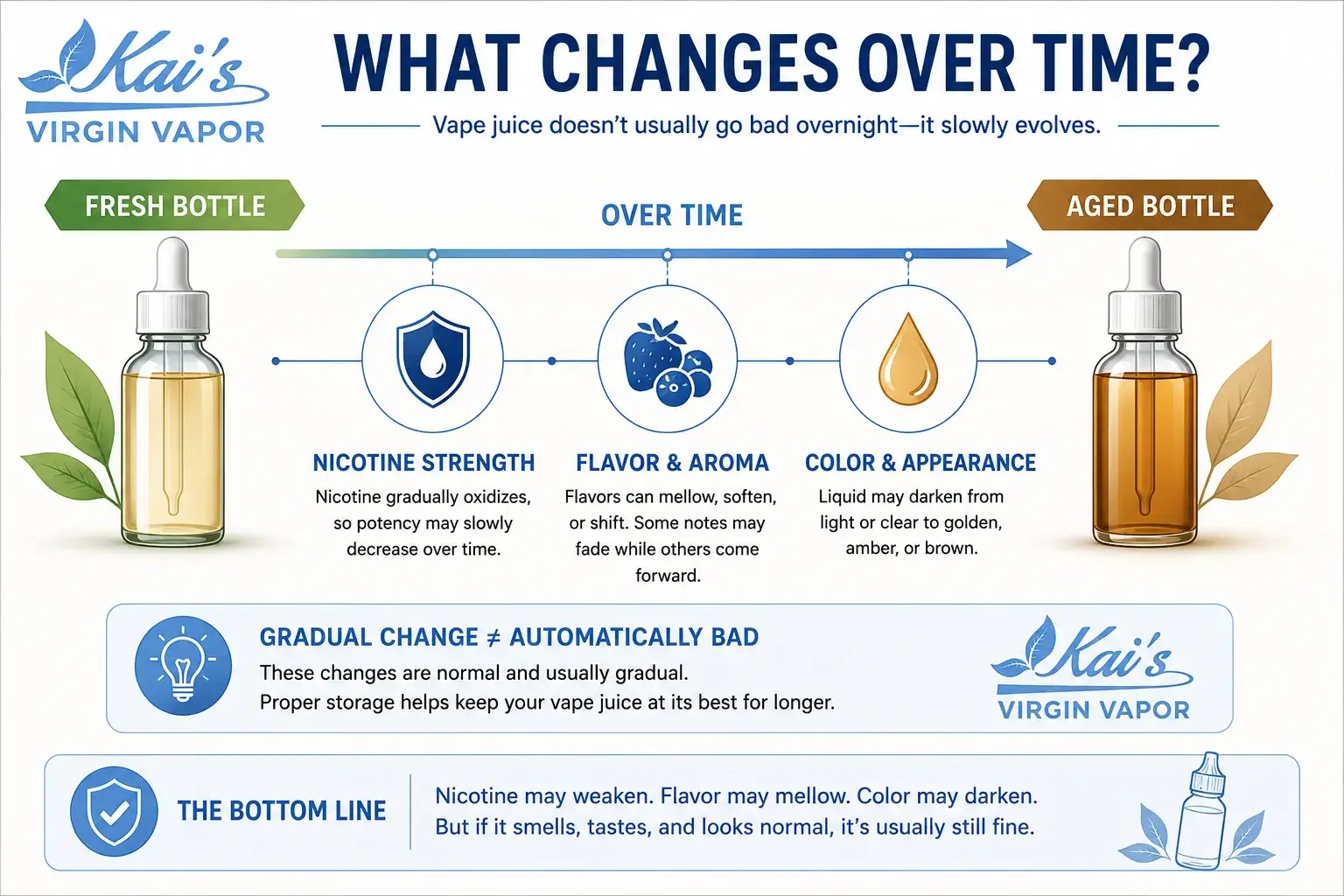
1. Nicotine Strength Slowly Declines
If there’s one thing that changes most predictably over time, it’s nicotine.
Nicotine gradually oxidizes when exposed to oxygen, heat, and light.¹ This is completely normal and one reason older nicotine-containing vape juice often becomes darker in color.
As nicotine oxidizes, a few things can happen:
- Nicotine potency may slowly decrease
- Flavor can become slightly harsher or flatter
- Liquid may darken from clear or pale gold to amber or brown
- Aroma may shift subtly
This process is generally gradual—not dramatic.
A bottle forgotten in a cool drawer for a year is very different from one left in a hot car or sunny windowsill.
Storage conditions matter enormously.
Interestingly, many people assume an expiration date means vape juice suddenly becomes unusable after a specific day. Reality is usually far more gradual.
Think of it more like coffee, spices, or olive oil:
At some point, freshness slowly declines—but there is rarely a dramatic “good one day, bad the next” moment.
2. Flavor Can Fade or Change
Flavor compounds naturally change over time.
Sometimes this is subtle. Sometimes it is noticeable.
A fruit flavor may taste softer or less vibrant. A dessert flavor may lose complexity. Floral or delicate notes can mellow.
Natural extracts can also evolve slightly over long periods—particularly in products made without heavy artificial sweeteners or flavor masking.
That does not automatically mean the vape juice is unsafe.
It may simply mean it no longer tastes exactly the way it did when fresh.
A practical question to ask yourself:
“Does this still smell and taste normal?”
If the answer is yes, that’s generally a reassuring sign.
A Quick Note About “Steeping”
Interestingly, not all change over time is considered a bad thing.
Some vape juice connoisseurs intentionally let e-liquid sit and age for a period of time—a process called steeping.
The idea is that flavors slowly blend, mellow, and deepen over time, sometimes creating a richer or smoother experience.
You might think of it a little like aging coffee beans or giving a fine wine time to settle and mature.
In our experience, there really can be something to it—particularly with high-VG or naturally flavored e-liquids. PG is generally considered a stronger flavor carrier than VG. Because of this, some vapers feel flavor development may continue after bottling in high-VG e-liquids (like those manufactured by Kai’s Virgin Vapor) as flavors gradually meld and infuse the vegetable glycerin over time.
Wondering if vape juice can actually be 100% VG? Check out 100% VG Vape Juice: The Truth Most Companies Won’t Tell You.
That said, there’s an important distinction:
Steeping is not the same thing as very long-term aging.
Steeping is usually discussed in terms of days or weeks, while long-term storage over months or years may gradually reduce nicotine strength and change flavor in less predictable ways.
In other words:
A little aging may improve an e-liquid for some people. A lot of aging may simply change it.
👉 If you want to know more about steeping, check out our guide to steeping vape juice.
3. Color Changes Are Extremely Common
This is probably the biggest thing that scares people unnecessarily.
A customer opens a bottle and thinks:
“Why is my vape juice darker? Did it go bad?”
Usually: no.
Darkening is often a completely normal sign of oxidation—especially with nicotine-containing vape juice.¹
Nicotine naturally reacts with oxygen over time, which can gradually deepen color.
Other factors can contribute too:
- Heat exposure
- Light exposure
- Natural flavor extracts
- Steeping and aging
- Time itself
This is especially common with naturally derived ingredients and products that avoid artificial stabilizers or excessive sweeteners.
Darker does not automatically mean dangerous.
👉 For more on vape juice color variations, check out our page, Why Is My Vape Juice a Different Color From Last Time?
So… How Long Does Vape Juice Usually Last?
There’s no perfect universal answer, but here’s a practical rule of thumb:
Unopened vape juice: often remains in good condition for around 1-2 years or more when stored properly.² ³
Opened vape juice: usually still lasts quite a long time, though exposure to oxygen may gradually speed nicotine and flavor changes.
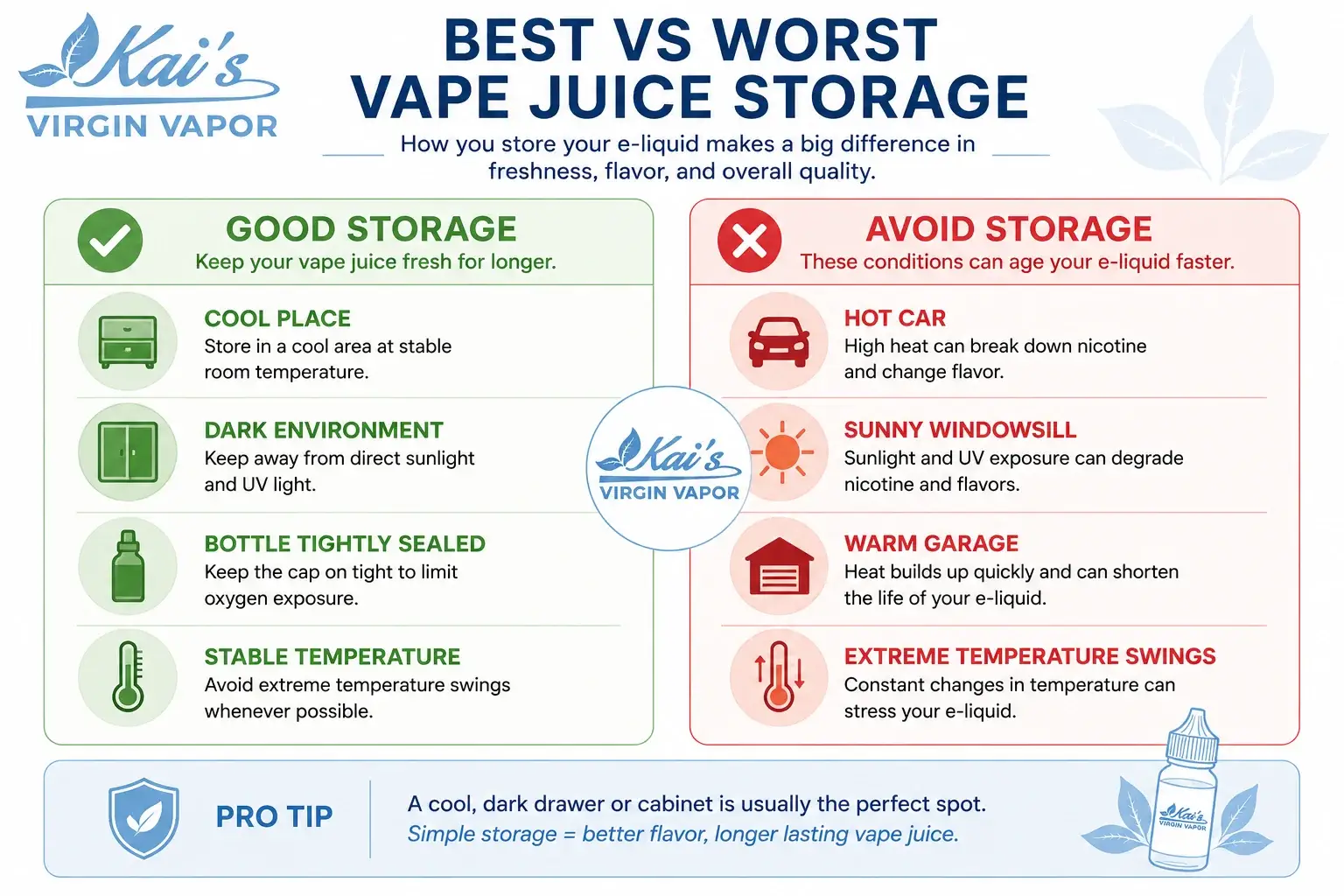
Again, storage matters:
Best-case storage:
✅ Cool
✅ Dark
✅ Dry
✅ Bottle tightly sealed
Worst-case storage:
❌ Hot car
❌ Sunny windowsill
❌ Frequently opened bottle
❌ Extreme heat or temperature swings
A cool drawer beats a hot glove compartment every time.
Signs You Probably Shouldn’t Use an Old Bottle
Most vape juice ages gradually—but occasionally a bottle raises red flags.
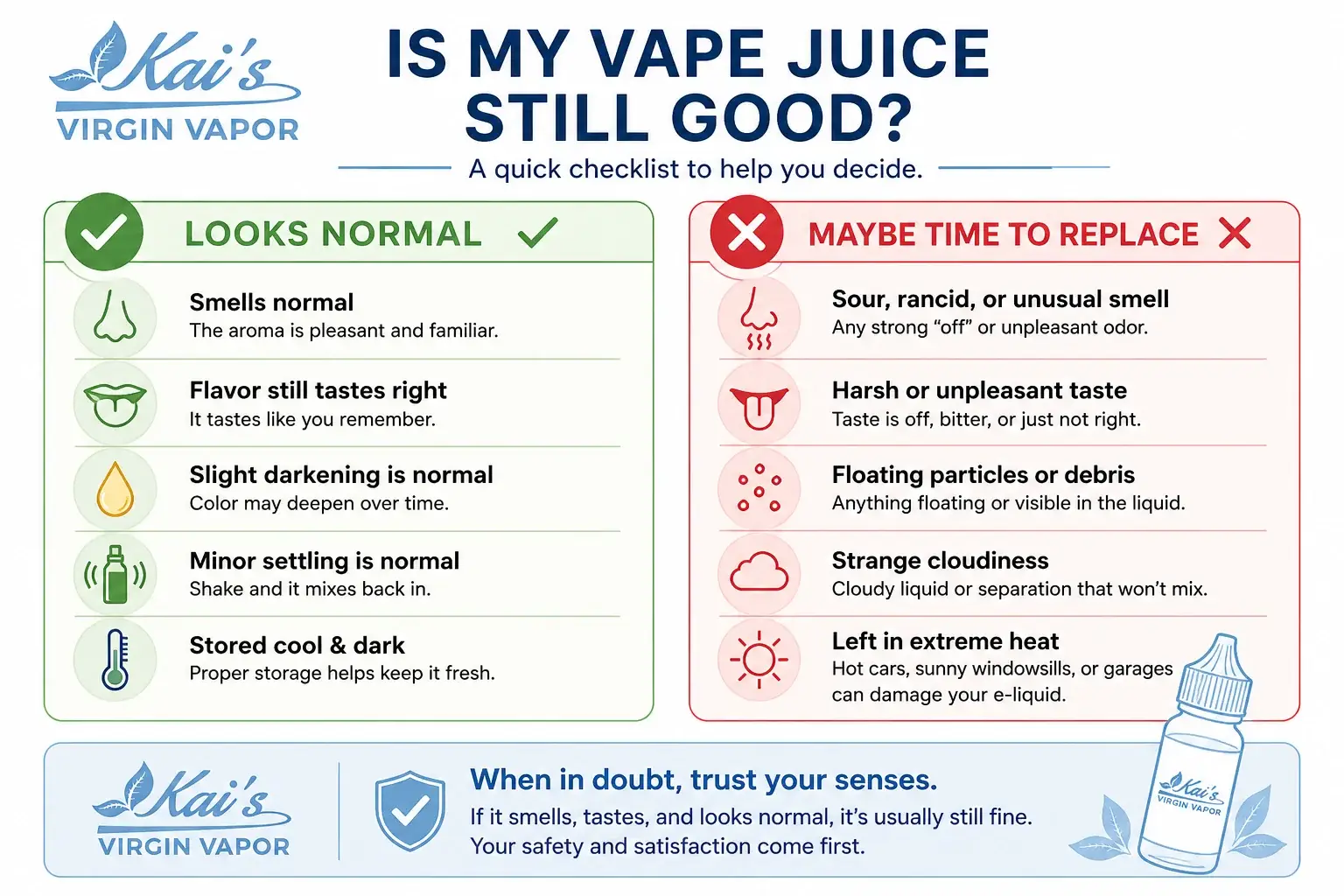
Here are a few signs it may be time to toss it and open a fresh one:
1. It Smells “Off”
Trust your nose.
If a vape juice suddenly smells sour, sharply chemical, rancid, unusually musty, or simply very different from what you remember, it may be best to replace it.
Flavor naturally changes over time, but a dramatically unpleasant smell is worth paying attention to.
2. The Flavor Seems Wrong
A little flavor fading?
Totally normal.
A subtle mellowing over time?
Also normal.
But if the flavor tastes distinctly unpleasant, harsh in a strange way, bitter, or “off,” it may simply be past its prime.
Sometimes an old bottle is not dangerous—it’s just no longer enjoyable.
👉 For more on why vape juice may taste weird, burnt, harsh, chemical-y, or just off, check out our post, Why Does my Vape Taste Weird?
3. Something Looks Strange
Normal changes:
✅ Slight darkening
✅ Golden, amber, or deeper tones over time
✅ Minor settling that mixes when shaken
Less normal:
❌ Visible contamination
❌ Cloudiness that doesn’t belong to the formula
❌ Floating particles or debris
❌ Separation that won’t remix after shaking
If something visually seems unusual compared with how the product normally looks, err on the side of caution.
4. It Was Stored Poorly
Context matters.
A bottle stored tightly sealed in a cool, dark drawer for years may remain in surprisingly good condition.
A bottle left in a hot car, garage, or sunny windowsill? Very different story.
Heat is one of the biggest accelerators of nicotine oxidation and flavor degradation.¹
Our Honest Experience With Very Old Vape Juice
Here’s the candid question people actually want to ask:
Have you ever vaped eliquid way past expiration?
The answer is, yes—we’ve served as guinea pigs and personally tested some very old vape juice!
Over the years, we occasionally rediscovered old bottles from Kai’s early days while cleaning or organizing.
Out of curiosity, we carefully inspected a few that had been stored reasonably well.
We checked:
- smell
- color
- taste
- overall appearance
And honestly?
They held up far better than we expected.
In a few cases, bottles that were many years old—even close to a decade old—still smelled good, tasted surprisingly normal, and remained usable.
That said, this comes with a giant asterisk:
We are not broadly recommending that people vape decade-old e-liquid.
Storage conditions matter enormously.
Nicotine strength may decline over time. Flavor accuracy can change. Every product ages differently.
Our takeaway was simply this:
Vape juice is often more stable than people fear.
The internet sometimes makes it sound like a bottle becomes dangerous the second it passes its best-by date.
Real life tends to be messier—and often much less dramatic.
Why Do Vape Juice Bottles Have Expiration Dates?
A fair question:
“If vape juice can last a long time, why do bottles have expiration dates?”
At Kai’s Virgin Vapor, our products generally carry a 2-year best-by date from manufacture.
That timeframe is based on the shelf-life expectations of our ingredients and a conservative quality standard—not because vape juice suddenly becomes unusable the moment a calendar flips.
In industries like pharmaceuticals and medical products, companies sometimes perform formal stability studies to scientifically establish expiration periods under controlled storage conditions. These studies can take years and are extremely expensive.
Because of that, many vape manufacturers instead establish shelf-life guidance using ingredient stability, internal quality standards, packaging considerations, and real-world experience.
Think of it less as:
“Danger after this date”
And more like:
“Best quality and freshness by this date.”
In many cases, properly stored vape juice may remain usable beyond that window—though nicotine strength, flavor, aroma, and overall experience may gradually change over time.
How to Make Vape Juice Last Longer
The good news?
Proper storage is simple.
If you want your vape juice to stay fresh as long as possible:
Keep It Cool
Room temperature is generally fine.
Avoid excessive heat whenever possible.
Try not to leave vape juice in:
❌ Hot cars
❌ Direct sunlight
❌ Warm garages
❌ Windowsills
Heat accelerates oxidation and can speed flavor changes.¹
Keep It Dark
Sunlight and UV exposure can contribute to nicotine degradation. A cabinet, drawer, or cupboard is ideal.
Keep It Sealed
Every time a bottle is opened, oxygen enters.
That doesn’t mean opening it is bad—it just means repeated exposure gradually contributes to change over time.
Keep caps tightly closed when not in use.
Buy Reasonable Quantities
This one is practical advice.
If you vape occasionally, buying years of supply at once may not make sense. If you have a favorite flavor and vape regularly, keeping a modest backup stash is usually perfectly reasonable.
If you do decide to keep a larger backup term stash on hand for longer periods of time, definitely store it somewhere cool. Some vapers looking to significantly prolong shelf life keep vape juice in the refrigerator or freezer. If you’re storing an emergency, set-it-and-forget-it stash for the apocalypse, refrigeration or freezer storage may make sense. But for normal day-to-day vaping, it’s definitely unnecessary.
Frequently Asked Questions
Can expired vape juice make you sick?
In many cases, older vape juice is simply weaker, darker, or less flavorful—not necessarily unsafe.
However, if a bottle smells wrong, tastes unpleasant, looks contaminated, or was stored poorly, replacing it is the safer choice.
When in doubt, trust your senses.
Does darker vape juice mean it expired?
Not necessarily.
Darkening is a normal result of nicotine oxidation and aging.¹
A darker bottle does not automatically mean something is wrong.
Does nicotine-free vape juice last longer?
Often, yes.
Because nicotine oxidation is one of the main visible changes in e-liquid over time, nicotine-free products may remain more stable in color and flavor.
Storage conditions still matter.
Should I refrigerate vape juice?
Usually unnecessary.
A cool, dark place at normal room temperature is generally sufficient.
Extreme heat matters far more than refrigeration.
How long does unopened vape juice last?
Many products remain in good condition for up to 2 years or longer if stored properly, though flavor and nicotine may gradually change over time.² ³
Final Thoughts
If there’s one takeaway here, it’s this:
Vape juice usually ages gradually—not dramatically.
Most of the time, an older bottle is not suddenly “bad.”
Instead, the more realistic question is:
“Does this still smell, taste, and look normal?”
Nicotine may slowly weaken. Flavor may mellow. Color may darken. But in many cases, properly stored vape juice lasts longer than people expect.
When in doubt, use common sense:
If something seems clearly off, replace it.
If it looks, smells, and tastes normal?
You may be pleasantly surprised.
References
- Talih S, Salman R, Karaoghlanian N, et al. Nicotine stability and e-liquid composition changes under storage and aerosolization conditions. Scientific Reports / analytical nicotine stability literature, 2023.
- U.S. Food & Drug Administration (FDA). E-cigarette liquid ingredient stability, storage, and nicotine chemistry background materials.
- Rowe RC, Sheskey PJ, Quinn ME. Handbook of Pharmaceutical Excipients. Information on glycerol (vegetable glycerin) and propylene glycol stability characteristics.
- Farsalinos KE, Gillman G. Carbonyl emissions, e-liquid stability, and factors influencing vape liquid composition over time. International Journal of Environmental Research and Public Health.