
Is 3 mg nicotine the same as 3%? Does a 6 mg vape deliver 6 mg of nicotine with every puff? And how does a 3 mg nicotine pouch compare to 3 mg vape juice?
If you’ve ever found nicotine labeling confusing, you’re not alone. Different products use different measurements, and even when two products contain the same amount of nicotine, that doesn’t necessarily mean your body will absorb the same amount.
Understanding what those numbers actually represent can help you make more informed decisions and avoid accidentally using a much higher nicotine concentration than you intended.
Let’s break it down.
1. What Does mg/mL Mean in Vape Juice?
Nicotine strength in e-liquid is generally measured in milligrams per milliliter (mg/mL).
This tells you how many milligrams of nicotine are contained in each milliliter of liquid.
For example:
- 3 mg/mL means every milliliter contains 3 milligrams of nicotine.
- 6 mg/mL means every milliliter contains 6 milligrams of nicotine.
- 12 mg/mL means every milliliter contains 12 milligrams of nicotine.
You’ll often see these shortened to 3 mg, 6 mg, or 12 mg on vape juice bottles. Technically, however, we’re talking about mg/mL, not the total amount of nicotine in the bottle.
How much nicotine is in the entire bottle?
To calculate the total nicotine content, multiply the concentration by the bottle size.
Nicotine concentration × Bottle volume = Total nicotine content
For a 60 mL bottle:
| Labeled Strength | Total Nicotine in Bottle |
|---|---|
| 0 mg/mL | 0 mg |
| 3 mg/mL | 180 mg |
| 6 mg/mL | 360 mg |
| 12 mg/mL | 720 mg |
| 18 mg/mL | 1,080 mg |
These figures represent the nicotine contained in the liquid, not the amount you will absorb by vaping it.
That’s an important distinction, and one we’ll return to shortly.
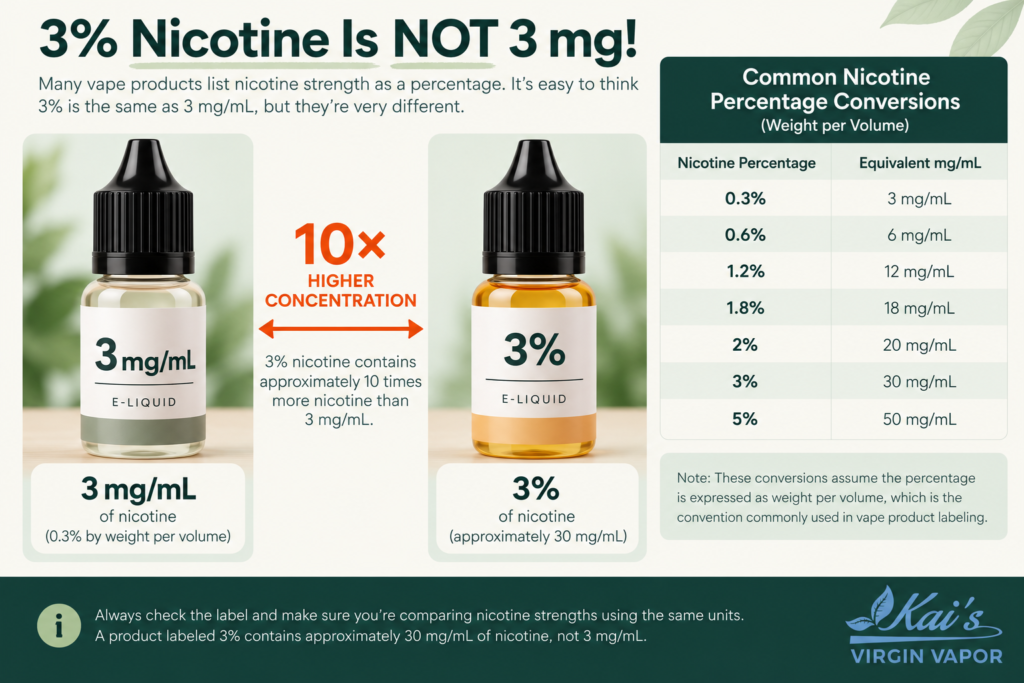
2. Nicotine Percentages Explained: 3% Is NOT 3 mg!
This is one of the most important labeling differences to understand.
Traditional bottled e-liquids commonly display nicotine concentration in mg/mL. Many disposable vapes, however, display nicotine strength as a percentage.
Unfortunately, the two systems are easy to confuse.
For nicotine percentages expressed by weight per volume (the convention commonly used in vape labeling), the approximate conversion is:
1% nicotine = 10 mg/mL
That means:
| Nicotine Percentage | Equivalent Concentration |
|---|---|
| 0.3% | 3 mg/mL |
| 0.6% | 6 mg/mL |
| 1.2% | 12 mg/mL |
| 1.8% | 18 mg/mL |
| 2% | 20 mg/mL |
| 3% | 30 mg/mL |
| 5% | 50 mg/mL |
Note: These conversions assume the percentage is expressed as weight per volume. A true weight-by-weight percentage requires the liquid’s density for an exact conversion.
Why this matters
Imagine someone who normally uses 3 mg/mL bottled vape juice purchasing a disposable labeled 3%.
They might reasonably assume they’re buying the same strength.
They’re not.
The disposable contains approximately 30 mg/mL — ten times the nicotine concentration of their usual e-liquid.
That doesn’t automatically mean they’ll absorb ten times as much nicotine, because devices and usage patterns differ. But it is a substantial difference in concentration, and one consumers should understand before switching products.
When comparing nicotine strengths, always convert the labels into the same units first.
3. Nicotine in Your Vape Juice Is Not the Same as Nicotine Absorbed by Your Body
Here’s another common misconception: if your vape juice contains 6 mg/mL nicotine, does that mean you’re absorbing 6 mg of nicotine?
No.
The number on the bottle tells you the nicotine concentration in the liquid. It doesn’t tell you how much nicotine enters your bloodstream.
Actual nicotine exposure depends on several factors, including:
- How much e-liquid your device vaporizes.
- How efficiently nicotine is transferred into the aerosol.
- How deeply and frequently you inhale.
- The duration of your vaping session.
- Your device and coil configuration.
- The nicotine formulation.
Not all nicotine contained in an e-liquid is necessarily transferred into the aerosol, inhaled, and absorbed by your body.
This is why you cannot calculate your personal nicotine absorption simply by looking at the number printed on a bottle.
Your device can make a big difference
Consider two people using exactly the same 6 mg/mL e-liquid.
One uses a small, lower-powered pod system that consumes relatively little liquid per puff.
The other uses a higher-powered device that produces substantially more aerosol and consumes more liquid with each puff.
Although the nicotine concentration is identical, the second device may deliver considerably more nicotine per puff because it vaporizes more e-liquid.
Coil resistance also matters, although resistance alone doesn’t determine nicotine delivery. Power settings, airflow, coil design, and the way someone uses the device all contribute.
This explains why an e-liquid that feels relatively mild in one device may feel considerably stronger in another.
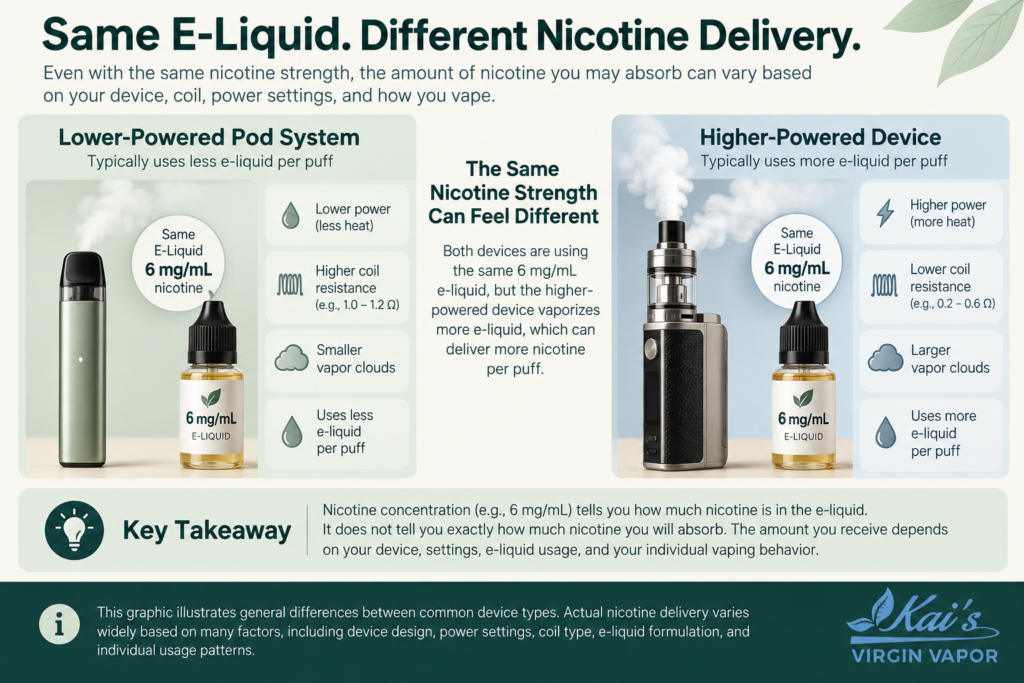
The takeaway: Nicotine concentration is only one part of nicotine exposure. Your hardware and vaping behavior matter, too.
For a more detailed discussion of selecting an appropriate strength, see our Nicotine Strength Guide: How to Choose the Right Level.
4. How Much Nicotine Is in a Traditional Cigarette?
If you’re familiar with traditional cigarettes, you might be wondering how their nicotine content compares with the numbers printed on vape juice bottles.
It’s a useful comparison, but there’s an important distinction between how much nicotine a cigarette contains and how much nicotine your body actually absorbs when you smoke it.
Nicotine content versus nicotine absorbed
A conventional cigarette contains approximately 8–20 mg of nicotine in its tobacco, with 10-15 mg being typical, depending on the brand, tobacco blend, and cigarette design.
However, you don’t absorb all of that nicotine when you smoke.
Research indicates that smoking a conventional cigarette typically results in approximately 1–2 mg of nicotine being absorbed into the body.
The remainder isn’t necessarily delivered to the smoker. Some nicotine is destroyed during combustion, some escapes in sidestream smoke, and some remains in the discarded cigarette butt or is otherwise not absorbed.
Here’s a helpful comparison:
| Product | Nicotine Content | Nicotine Absorbed |
|---|---|---|
| Traditional cigarette | Approximately 8–20 mg per cigarette | Typically 1–2 mg |
| 3 mg/mL e-liquid | 3 mg per mL | Varies with device and usage |
| 6 mg/mL e-liquid | 6 mg per mL | Varies with device and usage |
| 3 mg nicotine pouch | 3 mg per pouch | Varies with formulation and usage |
How many cigarettes equal 1 mL of vape juice?
This is a question we frequently encounter, but unfortunately, there isn’t a scientifically reliable universal conversion.
For example, one milliliter of 6 mg/mL vape juice contains 6 mg of nicotine. That does not mean vaping that milliliter is equivalent to smoking three to six cigarettes.
Why not?
Because we’d be comparing the total nicotine contained in the e-liquid with the estimated amount absorbed from smoking cigarettes — two different measurements.
Nicotine delivery from vaping also varies considerably depending on the device, power settings, liquid consumption, nicotine formulation, puffing behavior, and individual user.
Even two people using the same e-liquid may absorb different amounts of nicotine.
The same principle applies when comparing cigarettes with nicotine pouches.
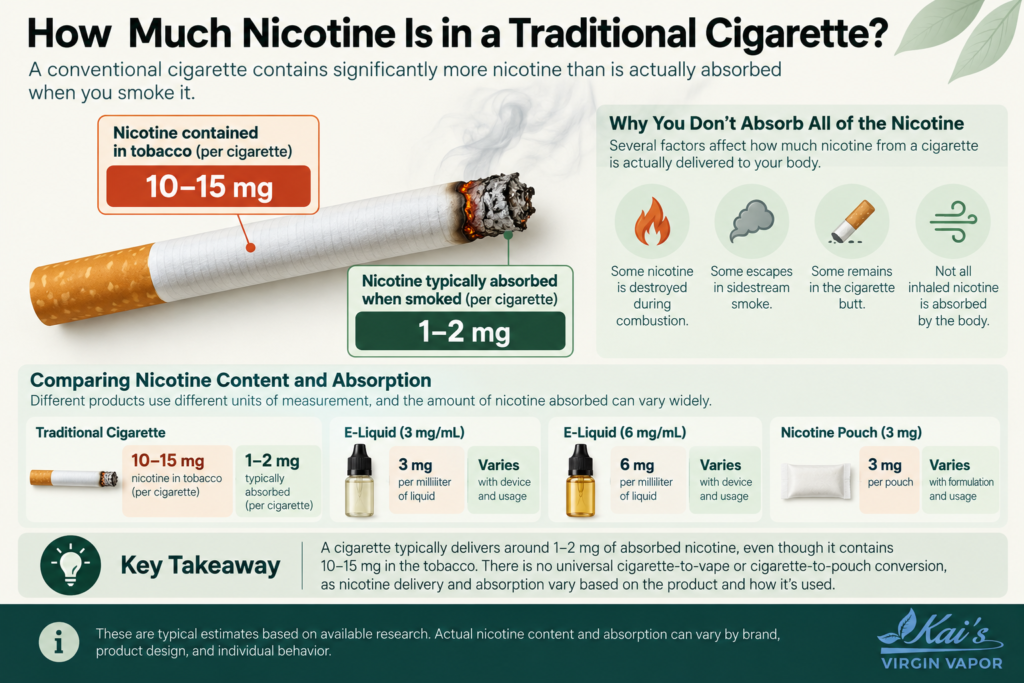
The takeaway: A cigarette typically delivers around 1–2 mg of absorbed nicotine, but there is no universal cigarette-to-vape or cigarette-to-pouch conversion. Product nicotine content and actual nicotine exposure are not interchangeable measurements.
5. What About Nicotine Salts? Are They Always Stronger?
Nicotine salts are frequently associated with high-strength vape products, particularly disposable vapes.
But nicotine salts are not inherently synonymous with high nicotine concentrations.
To understand why, it helps to know a little about nicotine chemistry.
Freebase nicotine versus nicotine salts
Nicotine is a naturally occurring chemical compound. In e-liquids, it is commonly formulated in two ways:
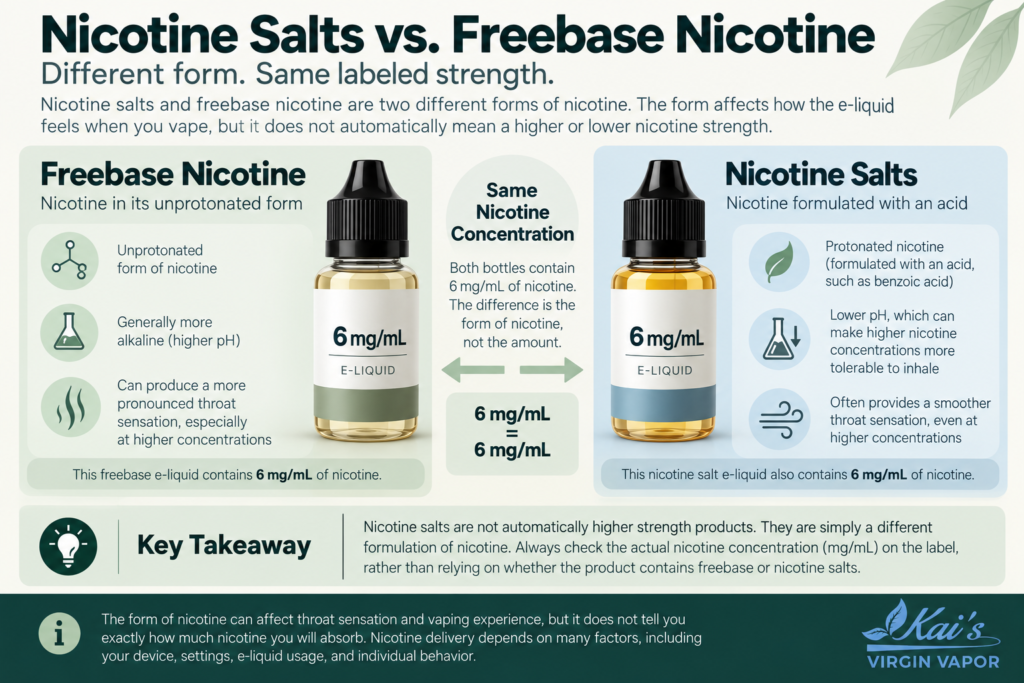
Freebase nicotine: Nicotine in its unprotonated, or freebase, form. Freebase formulations are generally more alkaline and can produce a more pronounced throat sensation, particularly at higher concentrations.
Nicotine salts: Nicotine formulated with an acid, such as benzoic acid, which protonates the nicotine and changes the formulation’s chemical properties, including its pH.
One of the major reasons nicotine salt formulations became popular was their ability to make much higher nicotine concentrations more tolerable to inhale.
For example, a 50 mg/mL freebase formulation would generally be extremely harsh for many users. A nicotine salt formulation can substantially reduce that harshness.
This helped enable the development and popularity of high-nicotine pod systems.
But here’s the important distinction:
Nicotine salt describes the form of nicotine. It does not tell you how much nicotine is present.
A 6 mg/mL nicotine salt e-liquid and a 6 mg/mL freebase e-liquid both contain a nominal nicotine concentration of 6 mg/mL.
They may differ in throat sensation, formulation characteristics, and nicotine delivery under particular conditions, but one is not automatically a higher-strength product simply because it contains nicotine salts.
Likewise, a smoother throat sensation does not necessarily mean a product delivers less nicotine.
When comparing products, look at the actual nicotine concentration rather than relying on whether the label says freebase or nicotine salt.
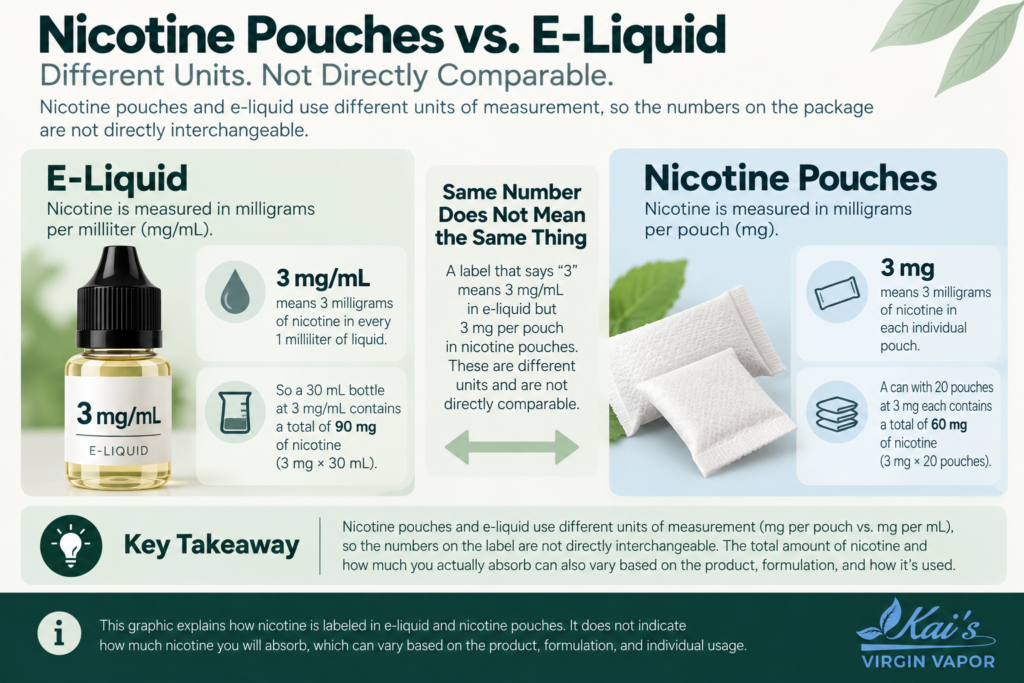
6. Is a 3 mg Nicotine Pouch the Same as 3 mg Vape Juice?
No — and this is another area where labeling can be particularly confusing.
Nicotine pouches and e-liquids typically use different units of measurement.
A vape juice labeled 3 mg generally means 3 mg of nicotine per milliliter of liquid.
A nicotine pouch labeled 3 mg generally means 3 mg of nicotine in that individual pouch.
These are entirely different measurements.
| Product | What the Label Means |
|---|---|
| 3 mg/mL vape juice | 3 mg nicotine per milliliter of liquid |
| 3 mg nicotine pouch | 3 mg nicotine per pouch |
| 6 mg nicotine pouch | 6 mg nicotine per pouch |
You also need to pay attention to pouch packaging, since some manufacturers express nicotine concentration as mg/g (milligrams per gram of pouch material) rather than mg per pouch.
Does that mean a 3 mg pouch delivers the same nicotine as vaping 1 mL of 3 mg/mL e-liquid?
Not necessarily.
Although both contain a nominal 3 mg of nicotine in this example, the amount your body actually absorbs may differ.
Vaping delivers nicotine through inhaled aerosol, with absorption occurring through the respiratory tract and other exposed tissues.
Nicotine pouches release nicotine into saliva, where a portion can be absorbed through the lining of the mouth. Some nicotine may also be swallowed.
The amount absorbed depends on the formulation, pH, duration of use, individual behavior, and other factors.
The timing of nicotine delivery can differ as well.
There is no reliable universal formula that allows you to say a particular pouch strength is equivalent to a particular vape juice concentration.
Bottom line: A 3 mg pouch is not interchangeable with 3 mg/mL e-liquid. The labels describe different things, and neither tells you exactly how much nicotine your body will absorb.
7. Can You Get Too Much Nicotine? Understanding Nicotine Poisoning
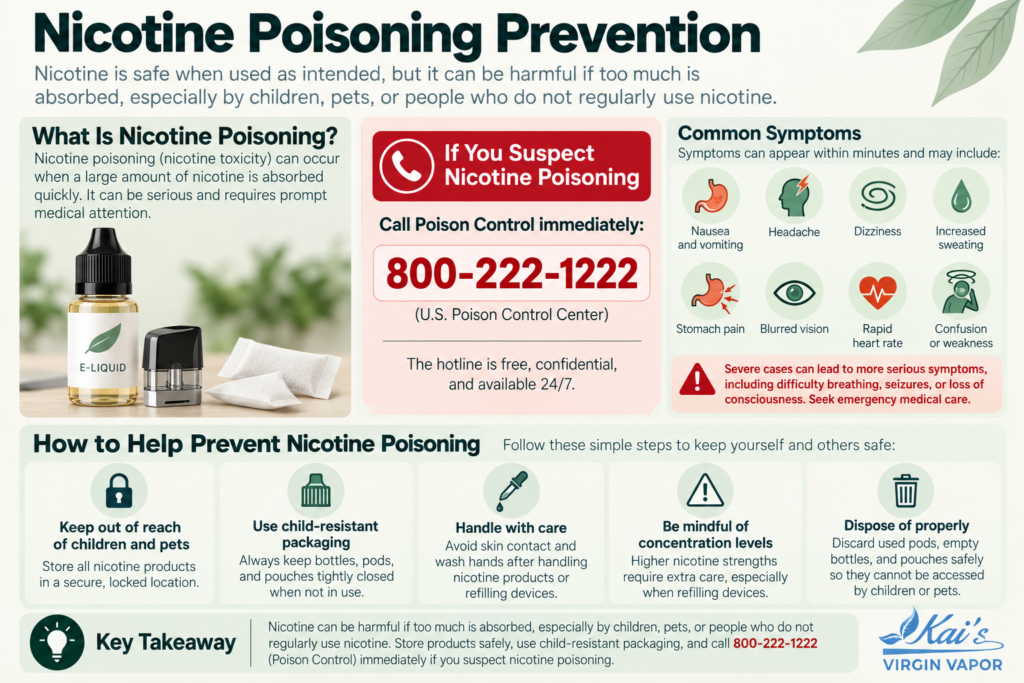
Yes. Nicotine is an addictive chemical, and excessive exposure can cause nicotine poisoning. Using higher strength products like 50 mg/mL common in disposable pods significantly increases the risk of nicotine poisoning.
Understanding nicotine concentration is important not only for comparing products but also for preventing accidental overexposure.
Signs of too much nicotine
Symptoms of nicotine overexposure or poisoning can include:
- Nausea or vomiting.
- Dizziness or headache.
- Excessive sweating or salivation.
- Abdominal discomfort.
- Rapid heartbeat.
- Weakness or confusion.
More severe poisoning can cause seizures, dangerous changes in heart rate or blood pressure, and difficulty breathing.
Symptoms can develop quickly.
If you begin feeling unwell while using nicotine, stop using the product. If poisoning is suspected, contact Poison Control promptly rather than waiting for symptoms to worsen.
Nicotine safety around children and pets
Liquid nicotine is particularly concerning because even a relatively small amount can present a serious poisoning risk to a young child.
Nicotine exposure can occur through swallowing, skin contact, or contact with the eyes.
Nicotine pouches, including used pouches that retain residual nicotine, also need to be kept away from children and pets.
A few important precautions:
- Keep all nicotine products securely stored, preferably locked away.
- Never leave open bottles, filled tanks, disposable vapes, or nicotine pouches within a child’s reach.
- Keep e-liquid in its original, properly labeled container.
- Clean up spills immediately and wash affected skin with soap and water.
- Dispose of used pouches and nicotine-containing products securely.
- Never assume that child-resistant packaging makes a product childproof.
If a child may have swallowed or otherwise been exposed to nicotine, seek guidance immediately, even if symptoms have not yet appeared.
In the United States, call Poison Control at 1-800-222-1222. The service is free and available 24 hours a day.
If someone has a seizure, collapses, cannot be awakened, or has difficulty breathing, call 911 immediately.
For additional information, read our article: Keeping Your Child and Yourself Safe from Nicotine Poisoning.
8. Quick Reference: What Nicotine Labels Actually Tell You
If there’s one thing to remember, it’s that nicotine labeling tells you how much nicotine a product contains — not necessarily how much nicotine your body will absorb.
Here’s a quick reference:
| Label | What It Actually Means |
|---|---|
| 3 mg/mL e-liquid | 3 mg nicotine per mL of liquid |
| 3% disposable vape | Approximately 30 mg nicotine per mL |
| 5% disposable vape | Approximately 50 mg nicotine per mL |
| 3 mg nicotine pouch | 3 mg nicotine in one pouch |
| Nicotine salt | A form of nicotine, not a specific strength |
| Freebase nicotine | A form of nicotine, not a specific strength |
| 0 mg/mL e-liquid | No intentionally added nicotine |
| Traditional cigarette | Typically contains 10–15 mg nicotine; approximately 1–2 mg absorbed when smoked |
Percentage conversions assume weight-per-volume labeling.
The Bottom Line
Nicotine strength isn’t quite as straightforward as the number printed on the package might suggest.
Understanding a few basic distinctions can help clear up much of the confusion:
- Milligrams per milliliter describe nicotine concentration in e-liquid.
- Nicotine percentages use a different labeling convention: 3% is approximately 30 mg/mL, not 3 mg/mL.
- The nicotine contained in a product is not necessarily the amount your body absorbs.
- Device settings, coil configuration, and usage patterns can substantially affect nicotine delivery.
- Nicotine salts are a different formulation of nicotine, not automatically a higher nicotine strength.
- Nicotine pouch strengths and vape juice concentrations cannot be compared directly.
Most importantly, nicotine is an addictive substance that requires careful handling and secure storage.
Understanding what the numbers mean is an important first step toward making informed decisions about nicotine products.
Want help understanding the different e-liquid strengths?
Read our companion article: Nicotine Strength Guide: How to Choose the Right Level.
References and Further Reading
- FDA — The Science of a Nicotine Standard for Combusted Tobacco Products
- U.S. Surgeon General (2010) — Nicotine Bioavailability and Absorption, Table 4.4
- America’s Poison Centers. E-Cigarettes and Liquid Nicotine.
- Poison Control. Dangers Associated with E-Cigarettes.
- CDC/NIOSH. Nicotine: Systemic Agent.
- Kai’s Virgin Vapor. Nicotine Strength Guide: How to Choose the Right Level.
- Kai’s Virgin Vapor. Keeping Your Child and Yourself Safe from Nicotine Poisoning.
Educational information only. Nicotine products are addictive and are not intended for children, non-users, or people who are pregnant. This article is not a substitute for individualized medical advice.